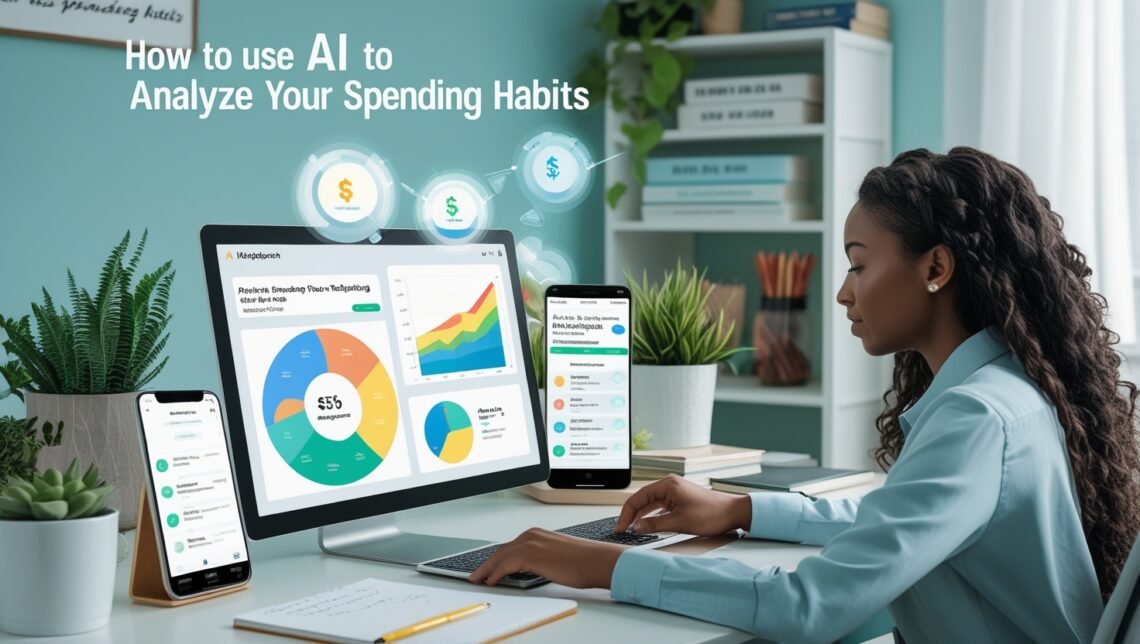
In today’s digital era, Artificial Intelligence (AI) is revolutionizing every field, and personal finance is also not spared. When we tried to understand our expenses earlier, we used to rely on manual budgeting, keeping receipts, or spreadsheets. But now with the advent of AI, this work can be done in a very easy and intelligent way. AI tools analyze your daily transactions, spending patterns, and financial behavior to give you deep insights that help you understand and manage your money better.
The biggest benefit of AI is that it automates repetitive and boring tasks. You don’t need to manually assign categories; the AI decides which transaction belongs to which category, like groceries, rent, or entertainment. Then, the AI gives you data-driven feedback that helps you understand where you are overspending and where you should cut down.
The purpose of this introduction is to show that today’s user can no longer leave their financial decisions to gut feelings or guesswork. With the help of data and analysis, AI makes personal finance smart and strategic. These tools not only provide convenience but also lay the foundation for long-term financial awareness and growth. With AI, you can gain more control over your money, which was previously only available to financial advisors.
Why Understanding Spending Habits Is Crucial:
Understanding your spending habits is very important for anyone, whether a student, a job holder, or a retiree. Every day, we spend money sometimes on small things like snacks or coffee, and sometimes on big things like shopping, rent, or travel. But most people have no idea where their money is going. And when the month ends, people are surprised why the money ran out so quickly. To avoid this confusion, it is important to analyze your spending habits.
When you start understanding your spending patterns, you will realize where you are spending unnecessarily. For example, if you order food from a restaurant 3-4 times every week, you might be shocked to see its monthly total. Spending analysis helps you identify which habits are making you financially unstable and which can be avoided.
This understanding is not only important for saving money, but it is also very important for future planning. If you want to set a savings plan, emergency fund, or investment goals, you will have to first understand your expenses. No budgeting or financial strategy can be effective without analyzing spending habits. That is why tracking these habits using AI tools has become very important and easy in today’s time.
How AI Tools Work in Spending Analysis:
When AI tools analyze your spending habits, they don’t make decisions based on just numbers, but try to understand the whole context. First, these tools collect transaction data from your bank account, credit cards, and digital wallets. The amount, date, and merchant name of every transaction are passed to the AI. By analyzing this data, the AI understands which expense belongs to which category, such as rent, groceries, shopping, bills, entertainment, etc.
When you shop from the same place repeatedly, the AI recognizes the pattern. For example, if you pay for a Netflix subscription every Sunday, the AI will automatically put it in ‘entertainment’. This automation saves the user from manual effort and provides accurate reporting. The AI then creates monthly, weekly, and even daily reports where you can see your total spend, category-wise spend, and comparison with past months.
The most powerful part of AI is predictive analysis. These tools also tell you, based on your past data, what your future balance will be if you continue to spend in the same pattern. The AI also provides personalized recommendations, like “You’re spending more than average on takeout” or “Try saving 10% from your entertainment budget.” These insights motivate the user to take action. This entire process happens in real-time or near real-time, which was previously difficult to get from a human advisor. AI tools make the work smart, accurate, and instant.
Top AI-Powered Apps for Expense Tracking:
There are many smart apps available today that use Artificial Intelligence to track your expenses and give you detailed feedback. These apps aim to give you control over your money without any hassle. Some of these AI apps are so advanced that they not only tell you you’re expenses but also give you customized suggestions based on your spending style.
One popular app is Cleo, which works like a chatbot. You casually talk to Cleo, and she tells you where you spent the most money this week. Apart from this, the app also gives you budgeting challenges that motivate the user to save. On the other hand, Mint is also a widely used app that syncs your multiple accounts and gives you real-time analytics on which categories you are spending the most in. YNAB (You Need a Budget) is also a powerful tool that teaches you the technique of assigning each rupee’s job so that your budget stays realistic and focused.
The role of AI here is to transform your raw data into meaningful insights. Apps like PocketGuard or Spendee also offer AI-driven budgeting and expense planning. The common goal of all these is to make you financially aware and avoid unnecessary spending. By using these apps, you can make your financial journey more disciplined and strategic.
Benefits and Limitations of Using AI for Personal Finances:
Using AI tools has become a smart decision in personal finance, but just like every technology has its pros and cons, AI financial coaching also has some benefits and some limitations. The first benefit is that AI tools give you real-time insights. You get to know your daily or weekly expenses, so that you can take corrective action on time. Secondly, AI recognizes the patterns of your spending habits and gives you smart suggestions like “now reduce spending in this category” or “increase savings.”
Personalization is also a strong point. Every user has different spending habits, and AI understands this and proposes different strategies for each user. AI never gets tired and is available 24/7. You can check your financial health whenever you want.
But there are some limitations. The first issue is privacy. AI tools access your sensitive financial data, and if there is a breach, the data can leak. The second problem is that AI tools are still limited in understanding the emotional or cultural context of each user. If you are spending due to any emotional or social reason, AI does not understand that background.
The third limitation is of over-reliance. People depend so much on AI that they stop using their financial judgment. Because of this, if the app ever misinterprets the user, then act blindly on it. So, using AI tools is a powerful method, but they should be used with understanding and awareness.
Conclusion:
Ultimately, AI has drastically changed the way we understand and manage personal finances. Where previously people had to write down their expenses using spreadsheets and notepads, now AI tools automatically collect data and provide you with spending insights. These not only save time but also help you make smart financial decisions.
AI makes budgeting easy for you, gives you analysis in every category, and also guides you in planning for the future. But it is best used when you have clear personal financial goals and use AI as a helper, not a replacement for your judgment. When you identify your unnecessary spending with the help of AI and focus on savings and investments, you become financially empowered.
The purpose of this blog is to show you how AI can bring financial discipline in your daily life. These tools don’t just give you numbers but make you a smarter, more responsible person who is accountable for every money decision. If you start using AI tools correctly today, you can be much closer to your financial goals tomorrow.
FAQs:
- How can AI help me understand my spending habits?
AI helps you understand your spending habits by analyzing your daily transactions, categorizing them into areas like groceries, rent, or entertainment, and identifying patterns. These insights help you realize where you’re overspending and where you can cut back. Unlike manual budgeting, AI tools work in real-time and automate the tracking process, making it more efficient and accurate. - What kind of AI tools are used for spending analysis, and how do they work?
AI tools work by connecting to your bank accounts, credit cards, and digital wallets. They collect transaction data—like date, amount, and merchant name and categorize your spending accordingly. Over time, these tools learn your habits, generate detailed reports, and offer predictions and personalized suggestions, such as budget alerts or savings tips, based on your behavior. - Which are the most popular AI-powered apps for expense tracking?
Some of the top AI-driven financial apps include Cleo, which uses a chatbot to make budgeting fun; Mint, which syncs all your accounts and provides real-time analytics; YNAB (You Need A Budget), which teaches proactive budgeting; and PocketGuard or Spendee, which offer custom insights and suggestions. These apps are designed to make money management easier and smarter. - What are the benefits and limitations of using AI in personal finance?
Benefits include real-time insights, automated expense categorization, 24/7 availability, and personalized advice. However, limitations include data privacy concerns, lack of emotional understanding, and the risk of over-reliance. While AI is powerful, it can misinterpret spending behavior if it doesn’t understand the context behind a purchase. - Can AI replace traditional budgeting and human financial judgment?
No, AI should be viewed as a helpful assistant, not a full replacement. It simplifies budgeting and provides deep insights, but it lacks emotional intelligence and cultural context. The best results come when AI is used alongside your personal financial goals and human judgment to make well-rounded decisions.